Kaleidoscope Exhibition at M2 Gallery
Exhibition Review
The most photographic object in Kaleidoscope was not a photograph.
It hung in a black frame on the far wall — a pen-and-ink drawing by Guy Little called Flight of the Rubric — and people stopped in front of it in a way they did not stop in front of most of the photographs, which is worth thinking about for a moment before we go any further. This was a photography-led group exhibition. Little is a photographer of four decades' standing. And the work he chose to put in the room was made by hand, slowly, with a pen.

Exhibition overview
What follows is less a review than an argument about what a room does that a screen cannot.
About Kaleidoscope
Kaleidoscope ran at M2 Gallery — Shop 4, 450 Elizabeth Street, Surry Hills, a few minutes' walk from Central — presented by Three Edge in late May 2025. M2 turns over something like forty exhibitions a year across painting, photography, illustration and sculpture, and there is a particular energy to a room like that: it has no house style to protect, which means the work has to hold the wall on its own.
Two IRID-represented photographers were in the show, Guy Little and Dani Watson. Both are ours, so discount our enthusiasm accordingly.
A theme that refuses to organise you
The best group show themes don't do the work for you.
Kaleidoscope is a word, not a brief. It gestures at pattern, reflection, fragmentation — the way a shape multiplies when you turn it — and then it stops and leaves the artists to their own devices. A tighter theme would have produced a tidier exhibition and a much less interesting one, because a tight theme makes everyone converge, and convergence is exactly what you don't want on a wall. You want disagreement. You want to walk in and feel the room pulling in several directions, so that the differences between artists become visible as choices rather than as style.
That is what it delivered, and the clearest way to see it is to look at what the two of them brought.
Dani Watson: abstraction found, abstraction made
Watson hung two works, and the pair is more interesting than either alone.
One is an aerial photograph: salt ponds seen from directly above, turquoise and chalk and a hard pale blue, cut through by the geometry of a causeway and a jetty, with a stack of white salt sitting in the middle of it like a graphic element someone has placed there. It is entirely a real landscape. It is also, at that altitude, entirely abstract — the ponds read as fields of colour, the infrastructure reads as line, and the only thing that gives away the scale is a small cluster of built forms you have to hunt for.

Beside it hangs the other: a hard-edged composition in orange and blue, an arc, a rectangle, a grey oval floating at the top of it, everything reduced to shape and colour and placed with an almost architectural deliberateness.

Put them next to each other and they make a proposition. One is abstraction found — a photographer who went up high enough that the world stopped looking like itself. The other is abstraction made — a photographer who found a scene and then removed from it until only structure was left. Same eye, two methods, and the pairing quietly asks which one you think is the more honest.
We'd add something more pointed, because a gallery that only compliments its own artists is of no use to anyone. The orange-and-blue picture resolves. It answers itself. That resolution is its strength — it reads instantly at ten paces and it gave the eye somewhere to rest in a busy room — and it is also its limit, because the works that stay with you tend to be the ones still asking a question. The aerial is the better of the two for exactly that reason: you keep going back to look for the scale.
Guy Little: the maze, the cube, and the wings
Which brings us to the drawing.
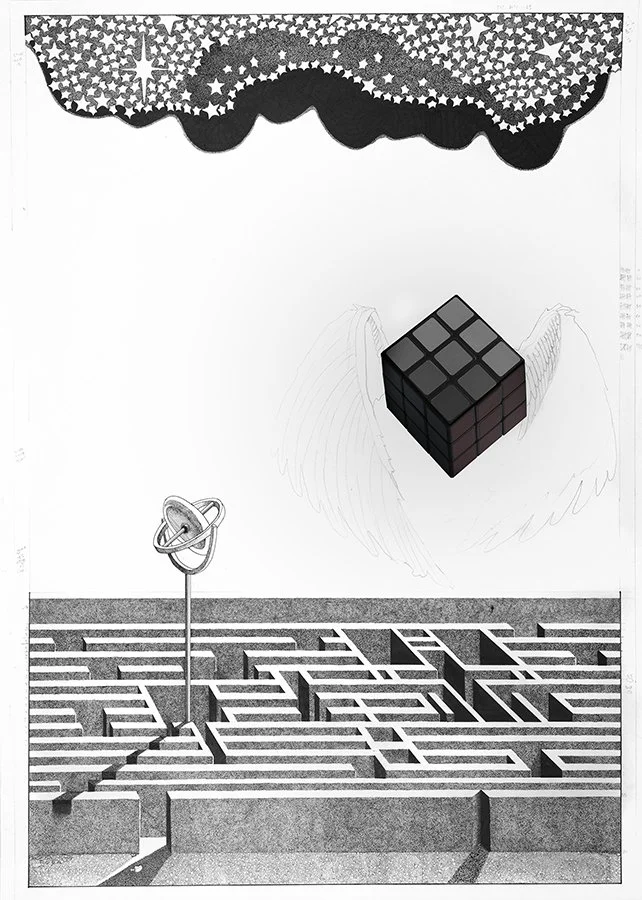
The lower half of the sheet is a labyrinth, drawn in careful grey perspective, its walls receding toward a horizon you cannot see over. Standing at its edge is a gyroscope on a slender pole — an instrument whose entire purpose is to know which way is up. Above the maze, floating, is a Rubik's cube. And behind the cube, sketched so faintly you might miss them, a pair of wings.
The cloud at the top of the sheet is black and full of stars.
A Rubik's cube is the archetype of a problem with a solution. It looks like chaos and it isn't: there is an algorithm, and once you know it the cube is no longer difficult, only tedious. A maze is the opposite kind of problem. You cannot solve it from outside; you can only walk it, and the walking is the whole thing. Little has put one directly above the other and given the solvable one wings — and the wings, note, are the least finished marks on the page. Flight is the wish. The maze is the fact. The gyroscope is the only tool you actually get.
There is a pun sitting in the title that we don't think is accidental. A rubric is a rule, a heading, a set of criteria by which work is assessed. Little has taught photography for more than three decades and has judged at national print award level. He has spent his working life administering rubrics, and here is one taking flight — or trying to, on wings that haven't quite been drawn in.
And this is why a drawing was the most photographic thing in the room. His photography asks how much can be removed before an image stops meaning anything; he spent nine years as a forensic and scientific photographer, in a discipline where nothing may be left out, and has spent the decades since finding out precisely how much can. The drawing asks the same question in reverse. Instead of subtracting from the world, he is building one, mark by mark, and deciding what has to exist for it to hold together. Photography and drawing, in his hands, are the same investigation approached from opposite ends. Standing in front of it, you can see him thinking.
What happens in the space between
Hang those works a wall apart and you get something none of them contains alone.
Watson's colour makes Little's grey feel austere. Little's density makes Watson's clarity feel like a held breath. Standing between them, the real difference emerges, and it isn't subject — it's speed. One work wants to be taken in; the other wants to be walked through. Speed is a decision an artist makes, as deliberately as they choose an aperture or a pen, and it is not visible in either work on its own. It is only visible in the adjacency.
That is the education a group exhibition provides and nothing else does. Not the theme. Not the wall text. The neighbours. And you could watch it happening in the room — people standing longer than they meant to, pointing things out to each other, arguing mildly in front of the drawing. Every collector we know built their eye by comparison rather than revelation: by seeing enough work in enough rooms that the differences became legible, and then discovering, slowly, which side of each difference they were on.
A room also tells the truth about scale and surface, which no screen has ever managed. These are physical objects. Tone behaves differently on cotton rag than backlit on glass; a large print does something to the body that a small one does not; and the white space in a drawing like Little's — which is most of the sheet — is not empty on a wall, it is loud, and you will never once experience that on a phone.
Which is the argument for going
IRID is, for most people, an online gallery, and the online part is a compromise. It is a very good one — it is how work reaches people who will never walk into a room in Surry Hills, and it is how most collections now begin. But the room is the real thing, and the collectors who develop fastest are the ones who keep turning up to exhibitions they have no intention of buying from.
So go to the group shows. Go to the ones with names in them you don't recognise, and especially the ones we have nothing to do with. Stand between two works that disagree with each other and watch what your eye does. That is the entire education, it costs nothing, and it will do more for your ability to choose a work than any amount of reading — this included.
Guy Little and Dani Watson are represented by IRID Gallery. Edition, framing and placement guidance is available on request.
