IRID certificate authentication
Authenticity, documented.
A Certificate of Authenticity forms part of the provenance of a photographic print. This page explains how IRID Gallery certificates are issued, identified and verified, and how the gallery can assist with certificates issued by its represented artists.
Certificate identification
How to recognise an IRID Gallery certificate.
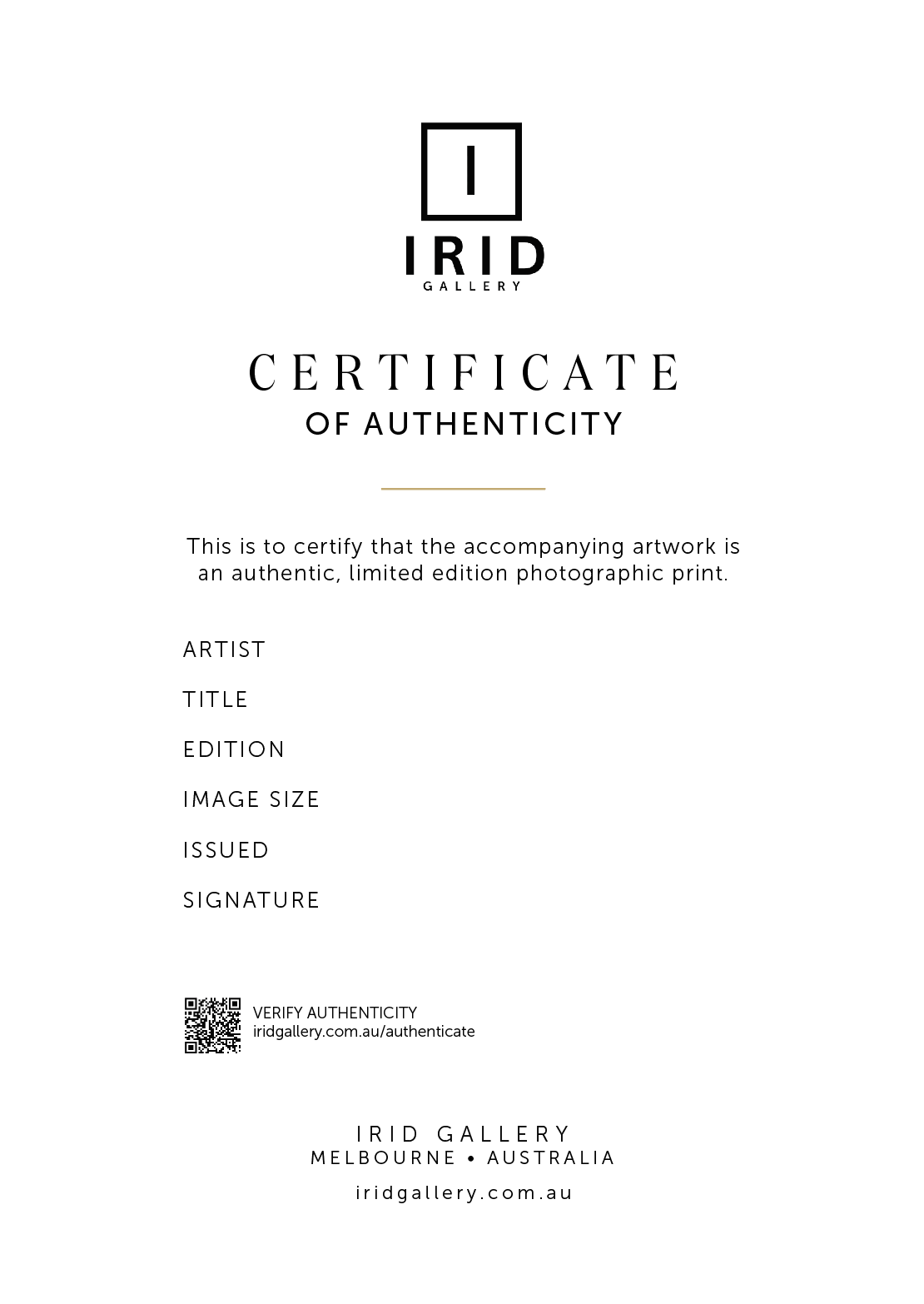
IRID Gallery certificates use a consistent format so collectors can clearly connect the document to the accompanying artwork. A complete certificate should agree with the details shown on the print, invoice and gallery record.
IRID Gallery branding
The gallery logo and Certificate of Authenticity title appear prominently on the document.
A blind embossed gallery seal
Every IRID Gallery-issued certificate is embossed. The seal is tactile and may not be obvious in a photograph.
Artist and title
The artist’s name and the exact title of the artwork are recorded.
Edition and image size
The numbered edition and the image dimensions identify the specific print format.
Issued date and signature
The certificate records when it was issued and includes the appropriate authorising signature.
IRID authentication QR code
The QR code links to this authentication page and the gallery’s verification process.
A certificate should never be assessed from one feature alone. IRID checks the embossing, document details, artwork markings and available gallery records together.
Certificate verification
Two certificate pathways, one considered review.
IRID Gallery can review certificates issued directly by the gallery and, where records are available, certificates issued by its represented photographers.
IRID Gallery-issued certificates
Checked against gallery records.
IRID-issued certificates can be reviewed against the gallery’s edition, sale and issue records. The certificate details, embossing, signature and accompanying artwork information should correspond with those records.
Artist-issued certificates
Supported for represented artists.
Some represented photographers issue their own Certificates of Authenticity. IRID Gallery can assist with verification when the artwork and certificate can be matched to available artist or gallery records. Artist confirmation may also be required.
Send clear photographs
Include the complete certificate, embossing, signature, edition notation and front and reverse of the artwork.
Records are reviewed
IRID compares the supplied information with available gallery, edition and artist records.
Receive a written outcome
The gallery will confirm what can be authenticated and identify any further information required.
Understanding editions
What makes a limited-edition photographic print?
Print number seven within a declared edition of twenty-five.
A fixed edition size
The total number of prints in the edition is declared and is not increased after release.
An individual edition number
Each print is identified within the edition, commonly using a notation such as 7/25.
Approved by the artist
The artist, estate or authorised representative approves the edition and its production standard.
A defined print specification
The image size, material, process and presentation are documented so the edition remains consistent.
Proofs and variants are disclosed
Artist proofs, alternate sizes and material variants should be identified separately from the numbered edition.
Documentation follows the artwork
The certificate, invoice and edition record connect the physical print to its artist, title and authorised production details.
A Certificate of Authenticity supports the provenance of the artwork, but the certificate, physical print, edition notation and available records should all correspond. An open edition may still be produced to a high standard, but it is not restricted to a declared total.
Certificate and provenance care
Keep the certificate with the life of the artwork.
The certificate should remain with the print throughout its ownership history. Together with the invoice and related records, it helps establish a clear and responsible chain of provenance.
Store it safelyKeep the certificate flat, dry and protected from direct light, moisture and unnecessary handling.
Keep records togetherRetain invoices, framing notes, condition reports and relevant gallery correspondence with the certificate.
Transfer it with the artworkWhen ownership changes, the certificate and supporting documentation should pass to the new collector.
Contact the gallery if uncertainDo not alter, replace or reproduce a certificate without first speaking with IRID Gallery.