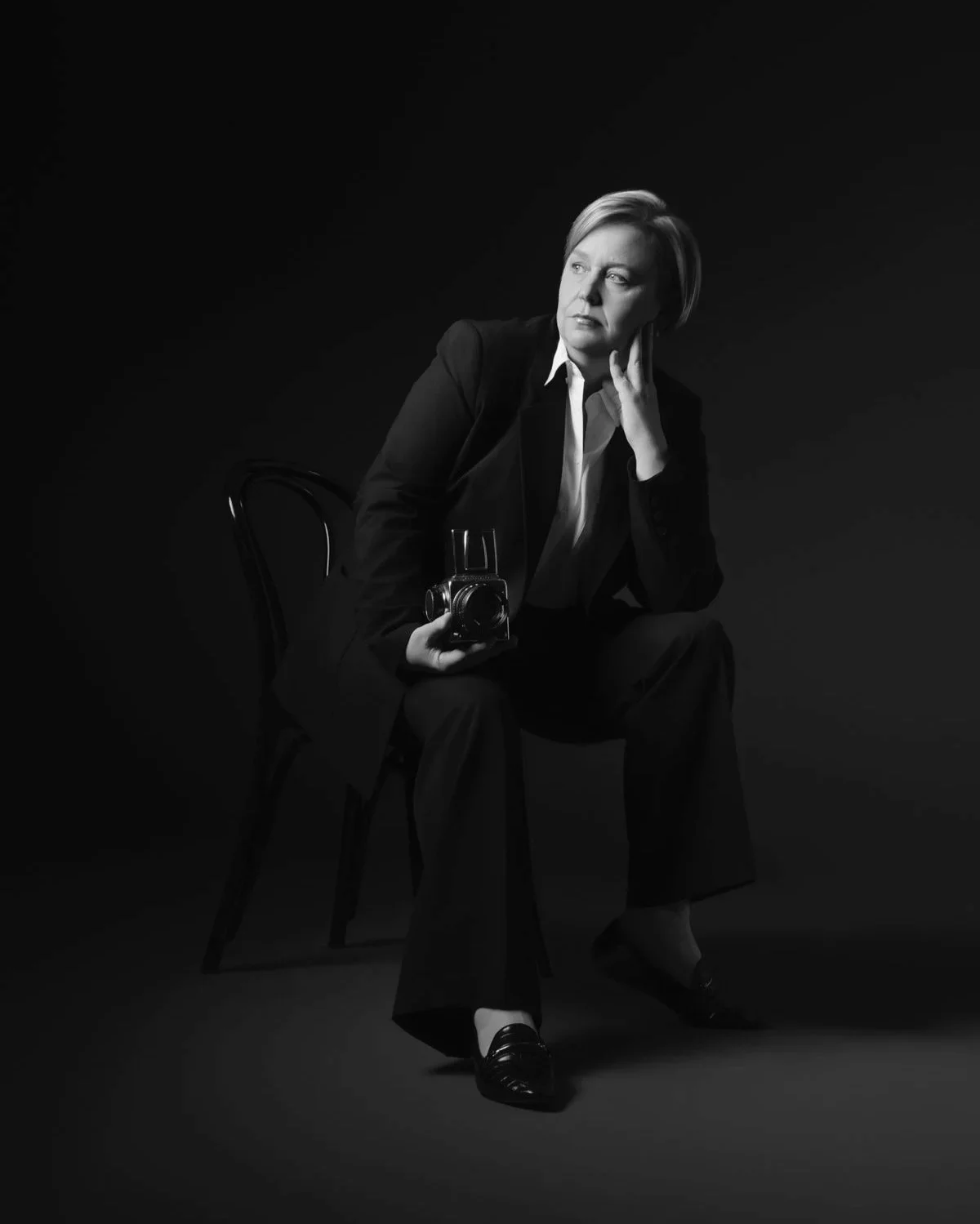
Guy Little: The Art of Taking Things Away
Artist Profile
The photographs were made in 1988. They have been waiting ever since.
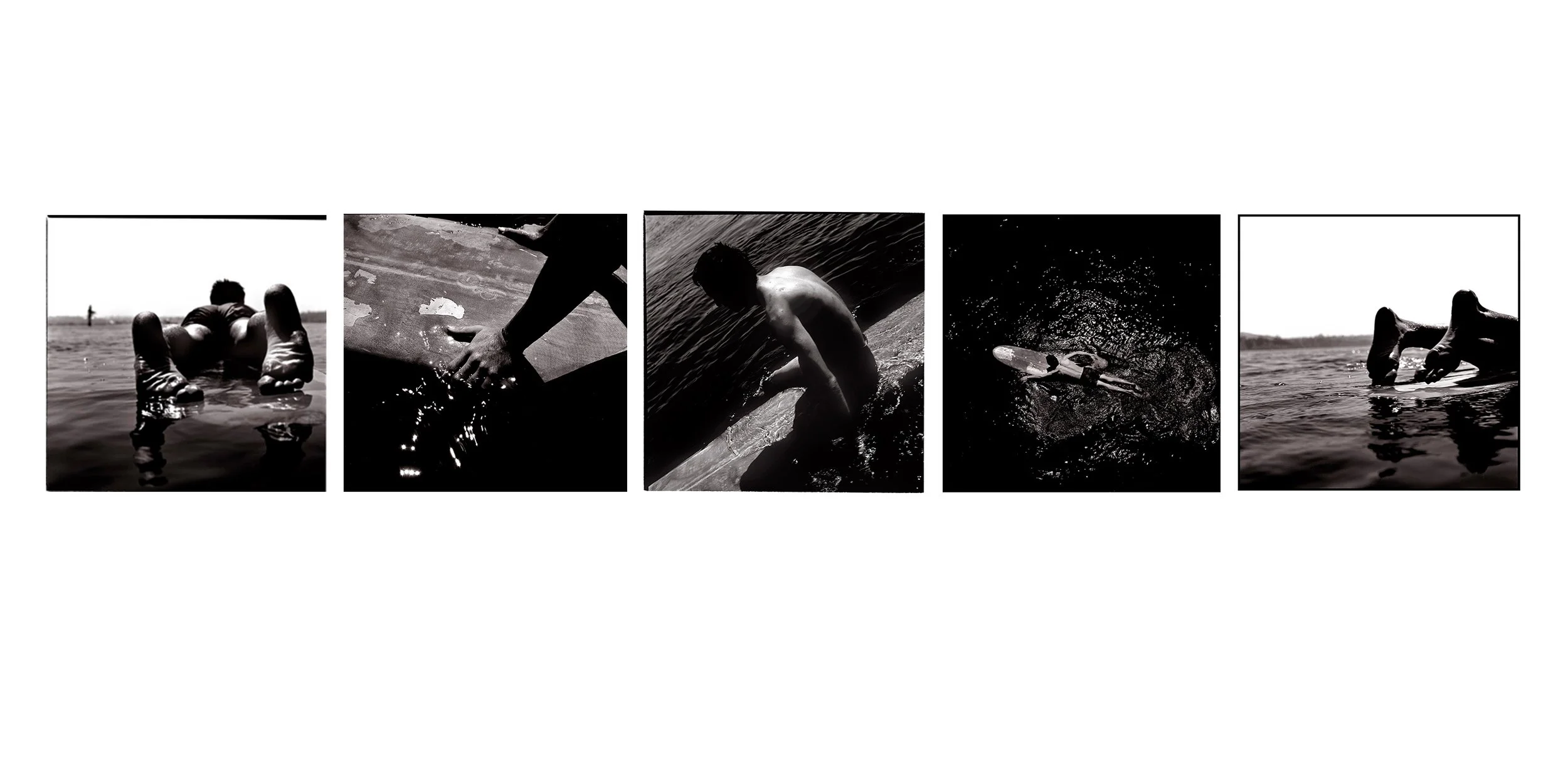
Guy Little went to the water with a camera nearly four decades ago and came back with a set of black-and-white studies of surfers — bodies, boards, spray, the hard glitter of reflected light on a moving surface. They are not sports photographs, though they contain sport. They are studies of a body doing something difficult inside a shape that will not hold still, and what survives in the frame is not the ride but the geometry of it: an arc, a wedge of white water, a figure reduced almost to a mark.
Most photographers would have printed them, shown them, and moved on. Little did something rarer. He kept working — for another thirty-eight years, across commercial studios, forensic laboratories, lecture theatres, an electron microscope, a drawing board — and the Surfing series stayed where it was, quietly correct, waiting for the moment when it could be made properly. That moment is now.
Photography, drawing, education and technical discipline meet in a practice developed across more than four decades.
The forensic years
To understand what Little does with an image, it helps to know what he spent nine years doing to them.
Before the galleries, before the teaching, he worked as a forensic and scientific photographer for the Federal Police in Sydney. It is a discipline with an ethic exactly opposite to art. A forensic photograph must be complete. It must include the thing you don't want and the thing you don't understand, because the photograph is a record and the record is not yours to edit. Nothing may be removed. Nothing may be emphasised. The image must be able to stand in a courtroom and be believed.
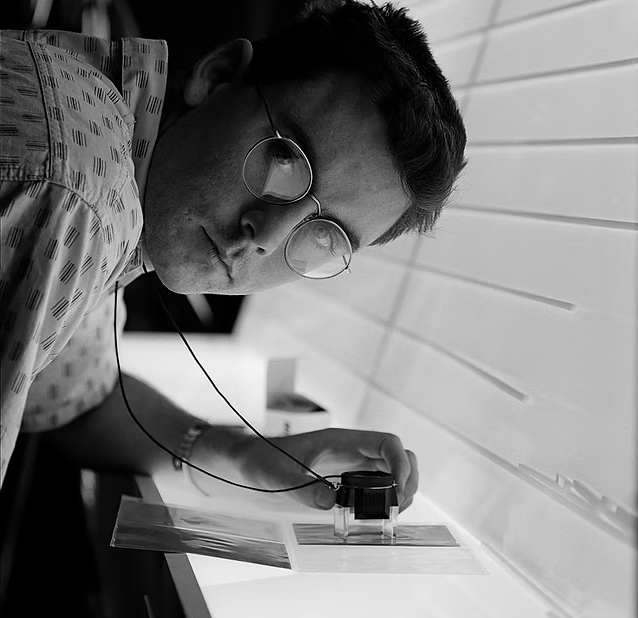
He also trained in scientific photography, in electron and scanning microscopy — making pictures at scales the human eye has no access to at all, where the question of what an image is for becomes very stark very quickly. Nine years of photographing things that had to be proved, and then a career spent photographing things that only have to be felt.
I don't think you can look at his work without seeing that inheritance. There is a rigour in it that most art photography simply doesn't have — an absolute technical control of tone, an unwillingness to let a highlight blow or a shadow collapse into mush, a sense that the print is not an approximation but a decision. And there is something else, harder to name: a photographer who spent a decade forbidden to leave anything out has spent the decades since finding out exactly how much he can.
What he removes
The question he keeps asking — it's practically the thesis of the practice — is how much can be taken away before an image stops meaning anything.
In the Surfing works, almost everything goes. Colour, first, which is the easiest and most consequential subtraction: strip the blue out of water and it stops being the sea and starts being tone, mass, texture, a field of information. Context goes next. There is rarely a horizon to orient you, rarely a beach, rarely any indication of scale. What's left is a figure, a curve, the black interval between two whites, and the strange discovery that a body in motion, photographed at the right thousandth of a second and printed with enough control, becomes an abstract mark that has not stopped being human.
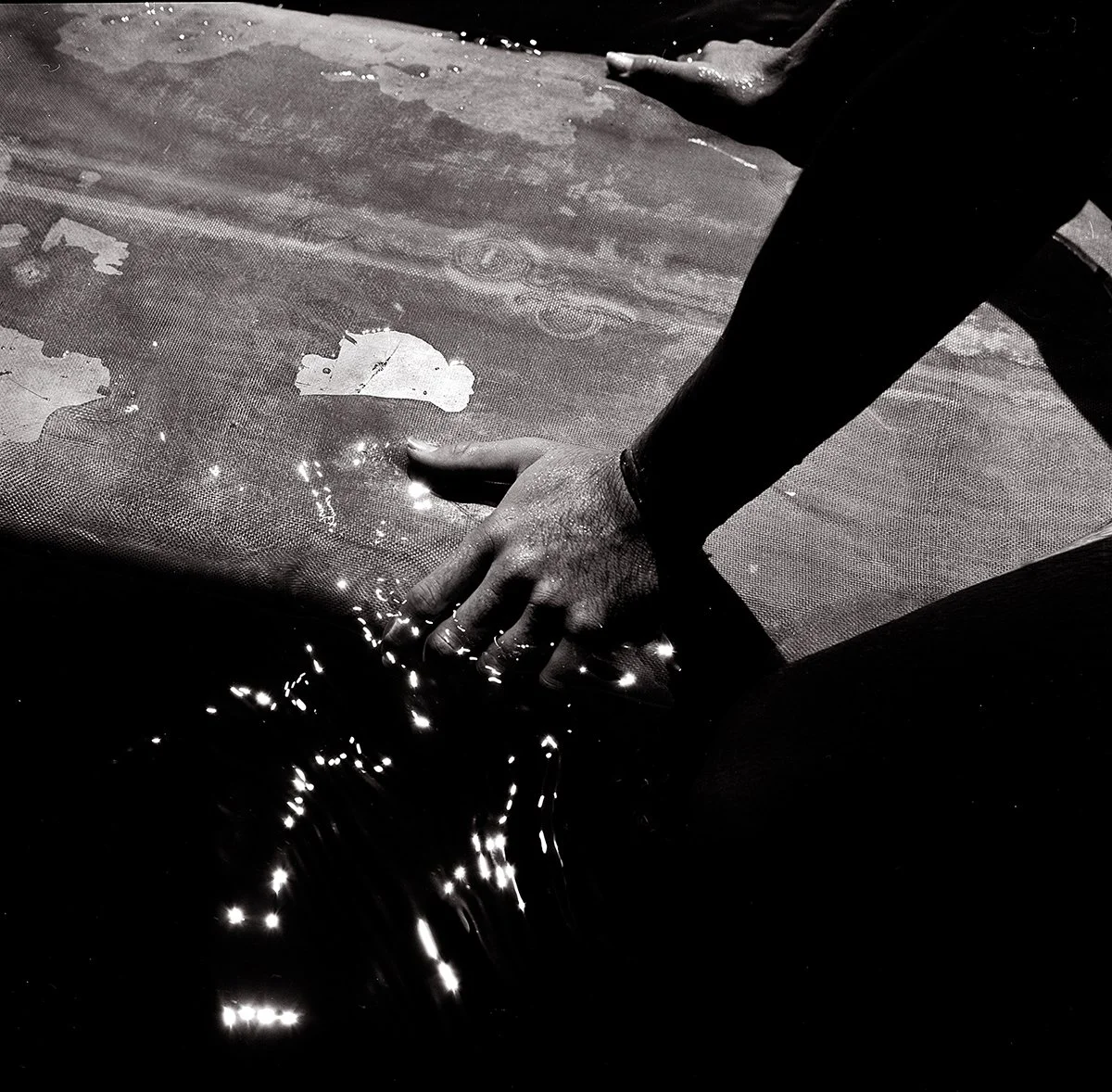
That tension is the entire pleasure of the series and it is why the pictures reward returning to. They sit exactly on the line between description and abstraction, and they refuse to fall off it in either direction. Look for two seconds and you see a surfer. Look for two minutes and you see a composition that would still work if you had never seen the ocean. Look for ten and you're back to the surfer, and the person, and the water that was, presumably, extremely cold.
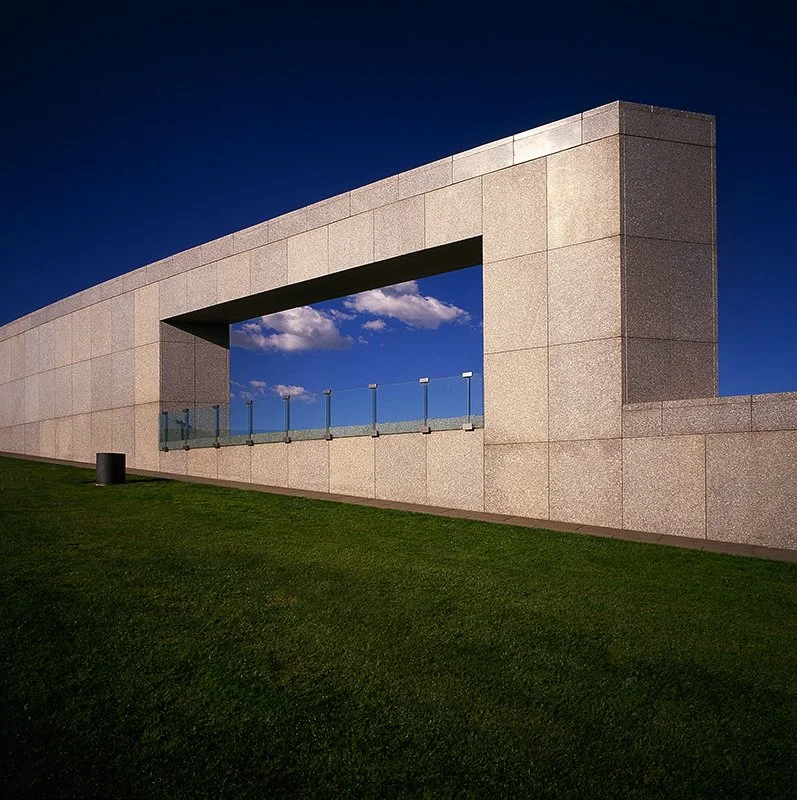
The same intelligence runs through his architectural work, where buildings are treated less as subjects than as proofs — proportion, negative space, controlled geometry, the order that is already inside a familiar place if someone will stand still long enough to find it.
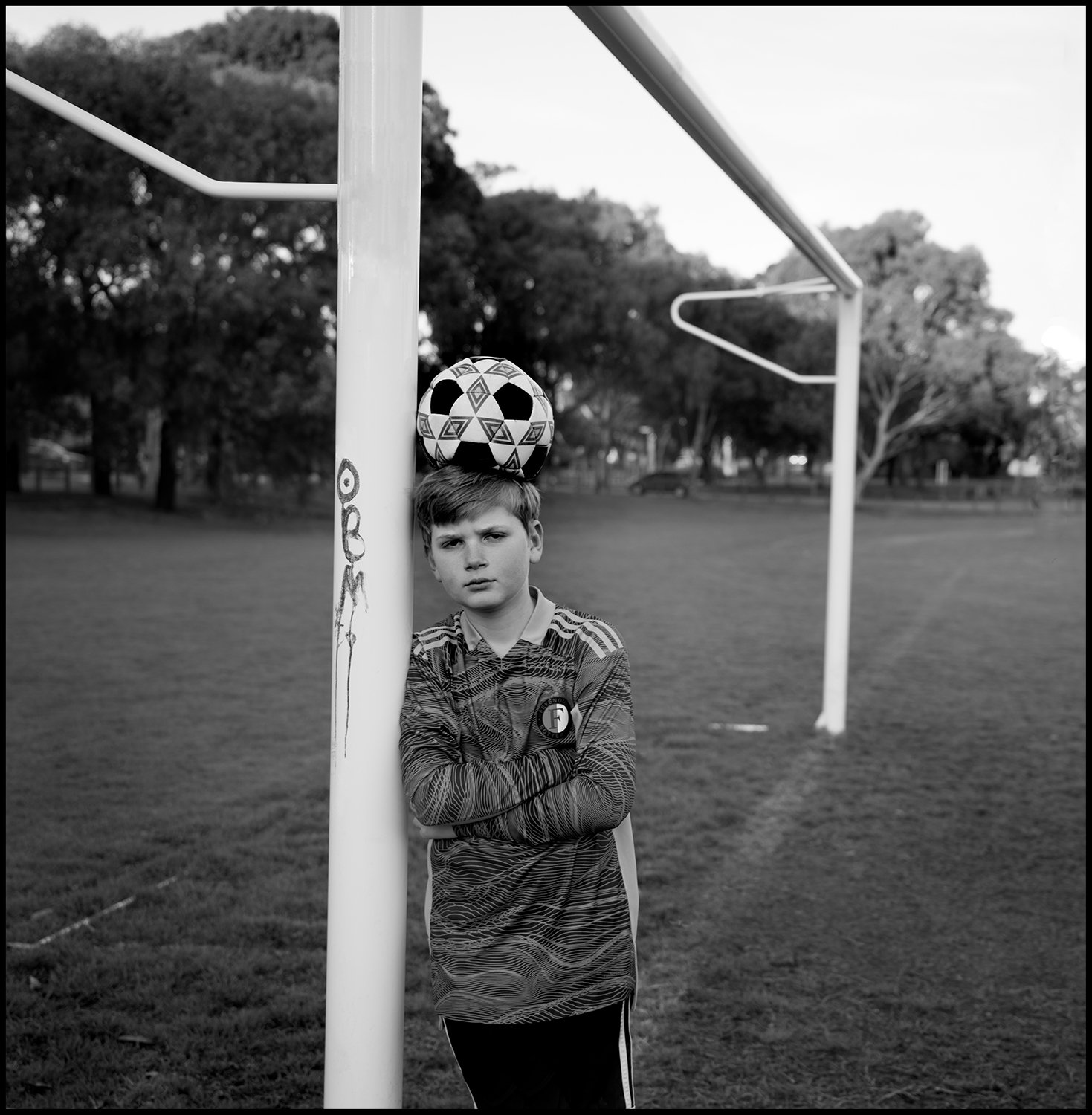
And it runs, differently, through the portraits. His goalkeeper picture — the one that took him to a finalist place in The Independent Photographer's People Award in London, judged by Steve McCurry, and from there into a Forbes piece — is a study of a person braced for something that hasn't happened yet. It's the same problem as the surfers, solved from the other end: not motion made still, but stillness that is entirely about motion.
The other hand
Little draws. Not as a hobby adjacent to the photography — as a second practice running alongside it, exhibited in its own right, including repeatedly in the Linden Postcard Show and through an artist residency with Bayside City Council at Billilla in Brighton.
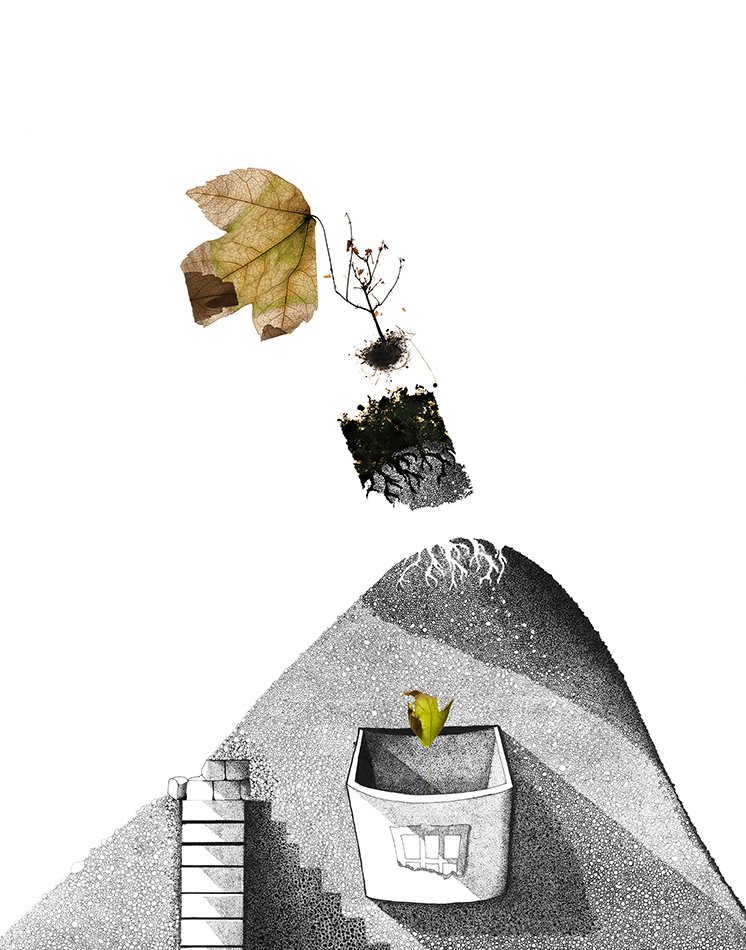
The drawings are dense, patient, obsessive things: line built up over line, symbolic and architectural at once, structures that seem to obey a logic they aren't sharing with you. They take the photographic thinking — repetition, contrast, the reduction of a complex subject to its essential mark — and slow it down to the speed of a pen.
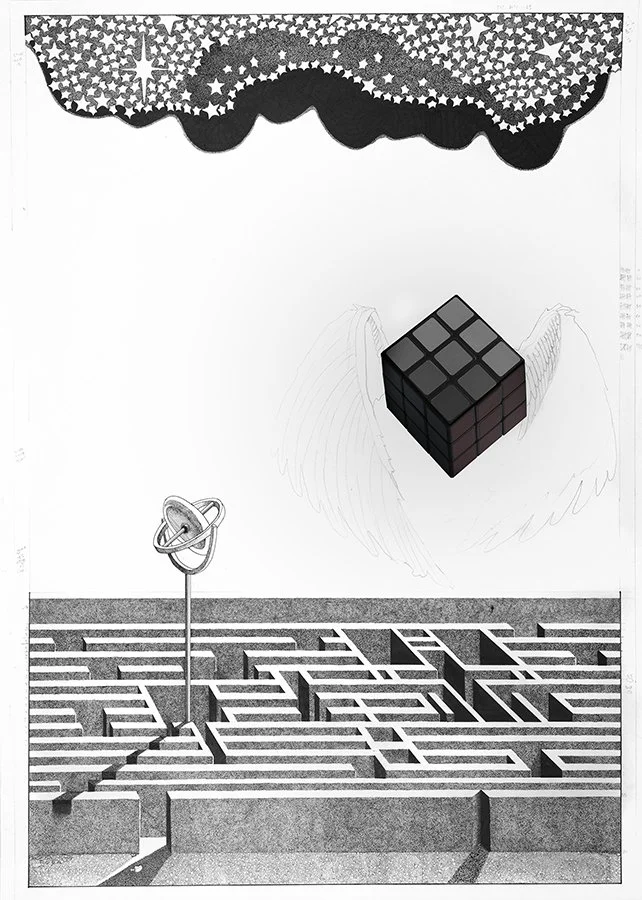
What strikes me about the two practices side by side is that they're asking the same question with opposite tools. The camera captures in a fraction of a second what the eye can't hold; the pen constructs over months what the eye has never seen. Both are attempts to get past the surface of looking to the structure underneath it. He is, in both mediums, a builder.
Citizenship of the medium
There is a part of Little's career that almost never gets mentioned in artist profiles because it isn't decorative, and it might be the part I respect most.
As Federal President and Chairman of the ACMP, he led the industry campaign to change the duration of copyright in photographs in Australia — a reform that was taken to Federal Parliament and passed in 2005. It is a deeply unglamorous piece of work. It involved committees. And it materially improved the position of every working photographer in this country, most of whom have no idea it happened or who did it.
Alongside that, he has taught for more than three decades — twenty-two years at RMIT, and subsequently at Photography Studies College, along with mentoring at masters level. There is a generation of Australian photographers working now whose technical grounding came, directly or at one remove, from him.
I mention this because it tells you something about the work. A photographer who spends years arguing about who owns an image, and years more teaching other people how to make one, is a photographer who takes the medium seriously as a thing with a past and a future — not as a channel, not as content. That seriousness is legible in every print he makes.
Still going
He is four decades into the practice and he has not settled, which is the rarest thing on this list.
In 2024 he completed a Master of Arts in Photography at Falmouth University in the United Kingdom — a serious, sustained piece of study undertaken at a point in a career when most people are consolidating rather than interrogating. In the years around it: a shortlisting from Graphis in New York, exhibitions with the Royal Photographic Society in London, work shown in Sydney at M2 Gallery, and the London finalist place under McCurry's eye. He has been an ARPS of the Royal Photographic Society since 1995 and has judged at national print award level. He has exhibited at Sotheby's in New York and at the Fuji Salon in Ginza. He was a finalist in the Olive Cotton Award.
None of that is why we represent him. We represent him because the work is good, and because it is the kind of good that gets better the longer you stand in front of it — which is the only criterion the gallery actually has.
Collecting Guy Little
The Surfing works are available through IRID as archival pigment prints on Canson Photographique 310gsm, 500 × 500mm, signed and numbered, from $3,000, and they are the natural entry point into the practice — the most resolved body of work, made at the height of his technical powers, and the one where the argument between description and abstraction is at its most beautifully unresolved.
A word of practical advice, since it's what I'd say to a collector standing next to me. Buy them in pairs if you can. The series is built on rhythm, and two of these hung together do something that one alone does not: the eye starts moving between them, comparing gesture to gesture, and the sequence — which is where the work actually lives — begins to assert itself. If you can only take one, take the one you argue with, not the one you like immediately. In my experience those are the works that are still holding your attention in five years, and the whole point of a photograph on a wall is that it should be.
The gallery can help with edition information, scale, framing and placement, and there are more works in his archive than are currently listed. If the Surfing series speaks to you, come and ask what else there is.