Dani Watson: The View From Above
Artist Profile
To photograph the way Dani Watson photographs, you have to leave the ground.
Her strongest work is made looking straight down — from a height, at a steep angle, with the horizon removed entirely. It's a difficult position to shoot from and an even more difficult one to think from, because the aerial view undoes almost everything a photographer is normally taught. There is no foreground leading you in, no sky, no obvious subject standing proud of its surroundings. There is only pattern, and the photographer's job stops being what do I point at and becomes what does the world look like when it forgets it's being seen from the front.
Watson has spent years finding out. The answer, in her hands, is stranger than a nice view.
Practice overview
Removing the horizon allows industrial landscapes, sporting courts and altered terrain to become systems of colour, line, scale and contradiction.
The reversal
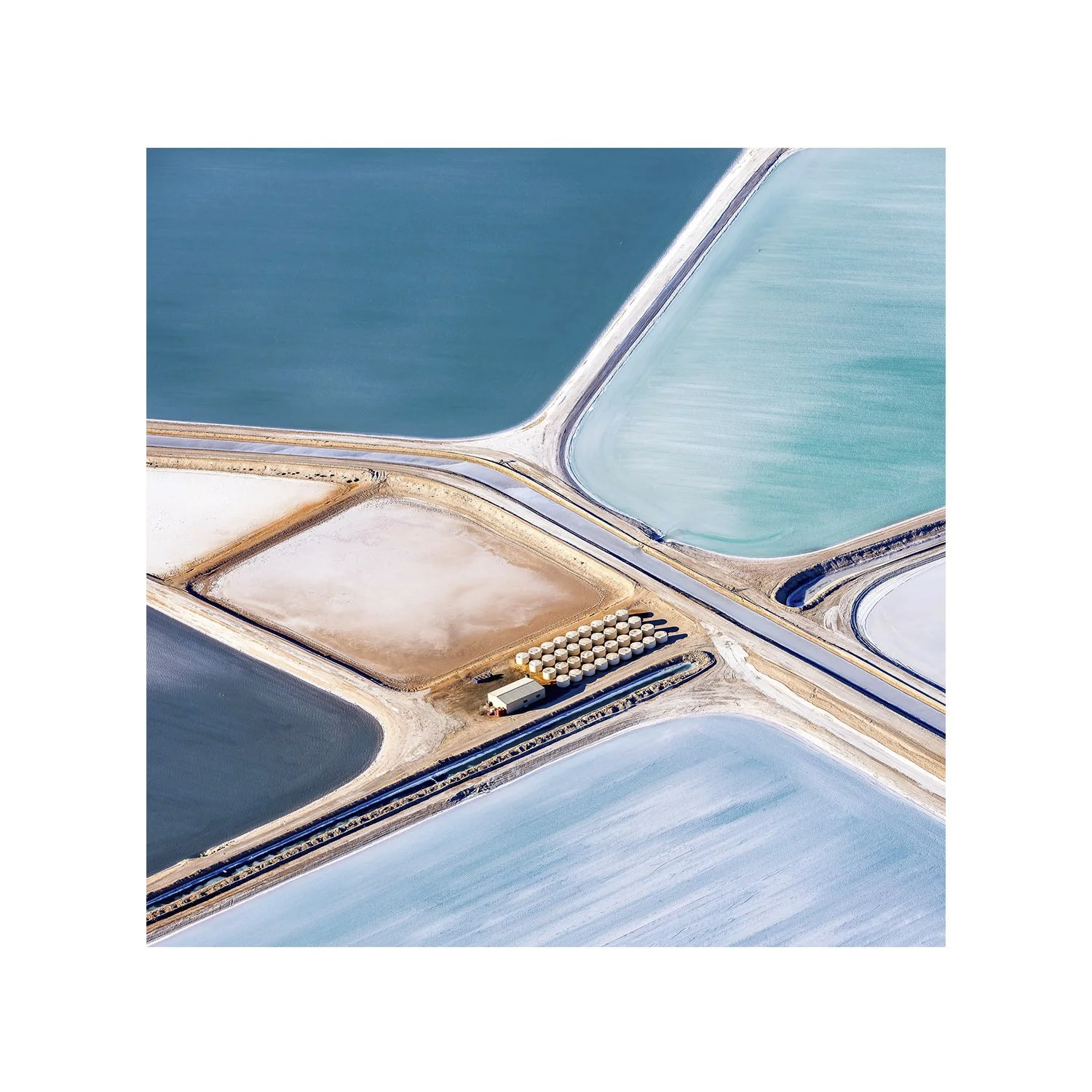
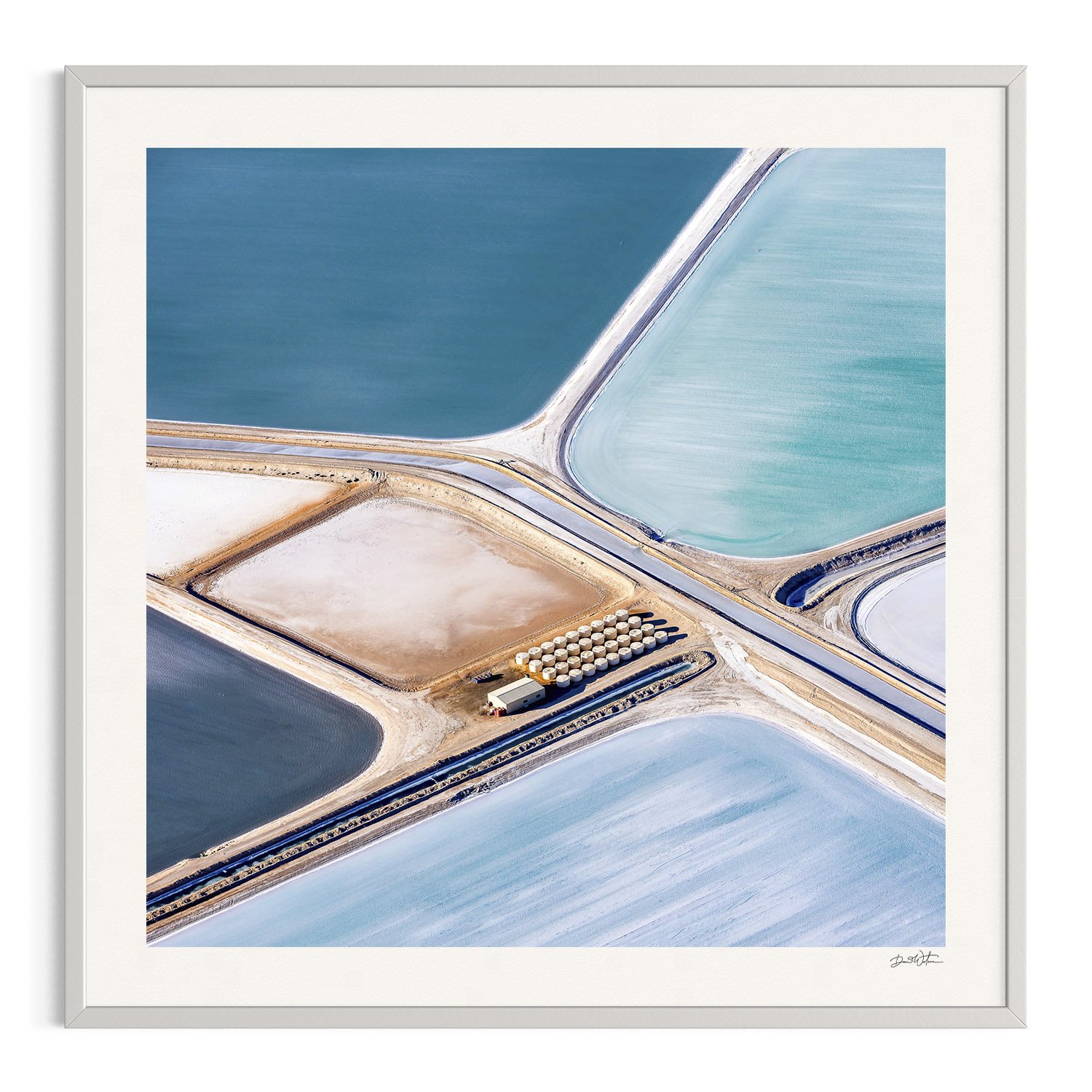
Take Useless Loop — the salt operation at Shark Bay in Western Australia, photographed from the air. It is an industrial site. Every line in it was drawn by an engineer: the evaporation ponds, the causeways, the jetty, the harvested salt stacked in the middle of the frame. It is one of the most heavily engineered landscapes in the country. And from a few hundred metres up it stops looking man-made at all. The ponds read as washes of turquoise and chalk, the infrastructure reads as brushstroke, and the whole thing resolves into something that looks less like heavy industry than like weather, or geology, or an abstract painting nobody signed. The image placed fourth in the Australian Landscape Photography Awards, and you can see why — it is the pure case of the genre, the moment a real place declines to look like itself.
Now set it beside her All Court Up series — basketball courts, also shot from directly overhead. Here the trick runs backwards. At first glance each image is a hard-edged abstraction: a field of colour, an arc, a rectangle, a floating oval. It is not an abstraction. It's a municipal sports court, and once you locate the ring and its shadow you cannot unsee it. The arc is the three-point line. The oval is the key. A surface someone designed with a ruler, for a game, reads from above as pure Mondrian.
Put the two bodies of work together and the observation declares itself, and it is a genuinely unsettling one. The salt works — entirely man-made — reads as nature. The basketball court — entirely designed — reads as art. Altitude does not neutralise the difference between the natural and the built. It reverses it. That is Watson's actual subject, and it is a real idea, sustained across a body of work, which is a rarer thing than a single striking picture.

Distance that reveals structure
There's a reason the aerial view suits her, and it goes deeper than novelty.
Some things are only true from a distance. Standing inside the salt works, you'd see machinery and mud and the ordinary ugliness of an industrial site. Standing on the basketball court, you'd see a basketball court. It is only by getting far enough away — high enough, detached enough — that the structure underneath becomes legible, that the pattern you could never have seen from within suddenly resolves into something worth looking at. Watson's whole method is built on that principle: that the truth of a place is frequently invisible to anyone standing in it, and that the photographer's job is to find the vantage from which it appears.
This is what separates her aerials from the drone photography that fills every feed. Height alone is cheap now; anyone can buy it. What Watson is doing with height is not documenting how a place looks from above — it's using altitude to strip a subject of its function until only its form is left, and then discovering that the form tells a different, often contradictory story about what the thing actually is. The camera goes up. The meaning changes on the way.
The training, and the lineage
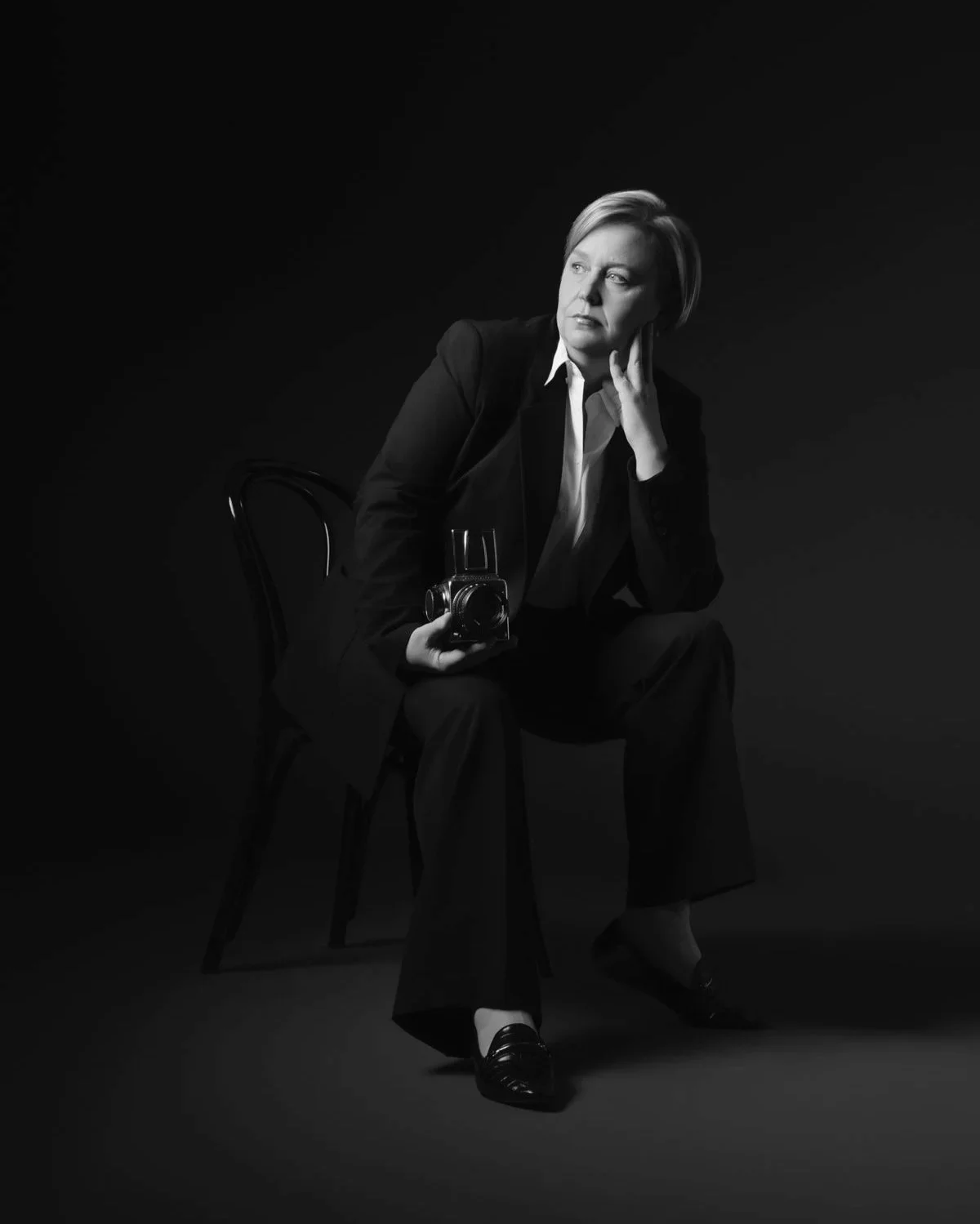
Watson didn't arrive at this from nowhere. Her formal photographic training began at RMIT, and she later completed a Master of Arts Photography at Photography Studies College, Melbourne. In 2026, she was named a Hasselblad Masters finalist — recognition of a photographer who has treated the medium as a discipline rather than a hobby that got out of hand.
And there's a lineage worth naming, because it connects her to another artist in this gallery. Watson's own development as a photographer runs back, like John Wiseman's, to time spent around Ken Duncan — the Australian landscape photographer whose insistence that a photograph is not finished until it exists as a printed, archival object has shaped a whole generation of practitioners. That conviction — that the work must become a physical thing, made to last — is one Watson holds firmly, and it's why her aerials exist as limited edition prints on archival paper rather than as images that live and die on a screen.
Where the work stops short — and where it doesn't
A profile that only praises isn't worth reading, so here is the honest assessment.
Watson's geometric, hard-edged compositions — the most immediately striking things she makes — have a limitation, and it's the one that afflicts all clean images: they resolve. Once you have found the ring in a basketball court, or read the shape of an orange-and-blue composition, the picture has largely told you what it's going to tell you. Its brilliance is front-loaded. It reads instantly at ten paces, which is a real skill and a real virtue in a room, but it is not the same as depth, and it would do her no favours to pretend the two are identical.
The aerials that don't fully resolve are the better work, and Useless Loop is the proof. You keep going back to it because the scale never quite arrives — that small cluster of buildings you have to hunt for to work out how big any of it is, the way the eye refuses to settle on whether it's looking at kilometres or centimetres. The picture withholds something, and the withholding is what keeps it alive on a wall for years. That tension between instant legibility and something-not-quite-resolved is where Watson's work is strongest, and it's the direction the practice is still moving in.
Collecting Dani Watson
Watson's aerial work is available through IRID as limited edition archival prints, signed and numbered, with full documentation and guidance on edition, scale and framing.
A note on scale in particular, because it matters more with this work than with almost any other: these are photographs about pattern and detachment, and they need room. Aerial abstraction printed small becomes decorative — a pretty shape on the wall. Printed large, it does the thing it was made to do, which is put you back at altitude, looking down, working out what you're seeing. If you're considering a Watson, consider it big, and see it printed before you commit — the tonal transitions in the salt ponds and the flat colour fields of the courts behave completely differently on cotton rag than they do on a screen.
And if you want the one that lasts: take the image that doesn't give itself up immediately. With this artist, that means the aerial where you can't quite find the scale, not the geometric piece that snaps into focus at a glance. The first will still be asking you questions in ten years. The second will have answered itself by the end of the first week.
Dani Watson is represented by IRID Gallery. Available editions, framing and placement guidance on request.
IRID Gallery can assist with available works, declared editions, print scale, framing and placement for private, corporate and interior collections.