Simon Ray: The Long Way Round
Artists
Simon Ray: The Long Way Round
Simon Ray's aerials and coastlines are easy to like at a glance. Which of them will still hold you once they are on your wall? A profile of the photographer, from a dark headland in 2016 to his editions at IRID.
In 2016 I stood on a headland on the Central Coast, north of Sydney, before sunrise, next to a man I had just met, and thought I was watching a beginner.
There were six of us that morning. I remember the cold, and the particular silence of photographers who have all stopped talking because the light has started. And I remember watching Simon work: patient, unhurried, in no rush to press the shutter. I put it down to temperament. What I was actually looking at was a training from twenty years earlier, never lost. It took me a long time to understand that.
Simon had been photographing since the nineties. Black and white film, at live music gigs.
What the gigs taught him
Shooting a band on film in the nineties is a hard school. The light is terrible and you control none of it. The subject won't hold still and won't take direction. You have thirty-six frames, they cost money, and you won't see one of them for days. No checking the screen, no bracketing, no second attempt. The picture happens in a quarter of a second somewhere in the middle of a song, and your whole job is to have decided, before it happens, where to stand, what to expose for and what a good moment will look like when it arrives.
I can't think of a harder training in anticipation, and it is exactly the skill landscape photography rewards, at a different tempo. A gig gives you a moment every few minutes. A headland gives you one every few months. The discipline is identical: be in position early, know what you are waiting for, don't waste the frame.
A gig gives you a moment every few minutes. A headland gives you one every few months.On the gigs
So the stillness I saw that first morning was a man who had learned, long before and in a much louder room, that the shutter is the last thing that happens.
The way back in
He came back to it by an unusual route: a podcast. Project Rawcast, one of those independent Australian photography shows that existed for the love of it, got him interested enough to pick the camera up properly. Then he went further than listening. He went on the workshops. Several of them, multi-day, with the people who made the show.
That is how six of us ended up on that headland. Careers like his usually begin this way: someone deciding to turn up somewhere at four in the morning, repeatedly, in the cold, with people further along than they are.
The year he committed
In 2022 Simon stopped treating photography as something he did around the edges of a life, and started treating it as the work.
Most photographers with real ability spend years in the same holding pattern. The work is good, the intention is genuine, and the decision to commit can always be made next year. Simon made it.
Two ways of standing still
Simon works in two registers that look unrelated at first: aerial, and landscape at ground level. Hang one of each together and the connection is obvious.
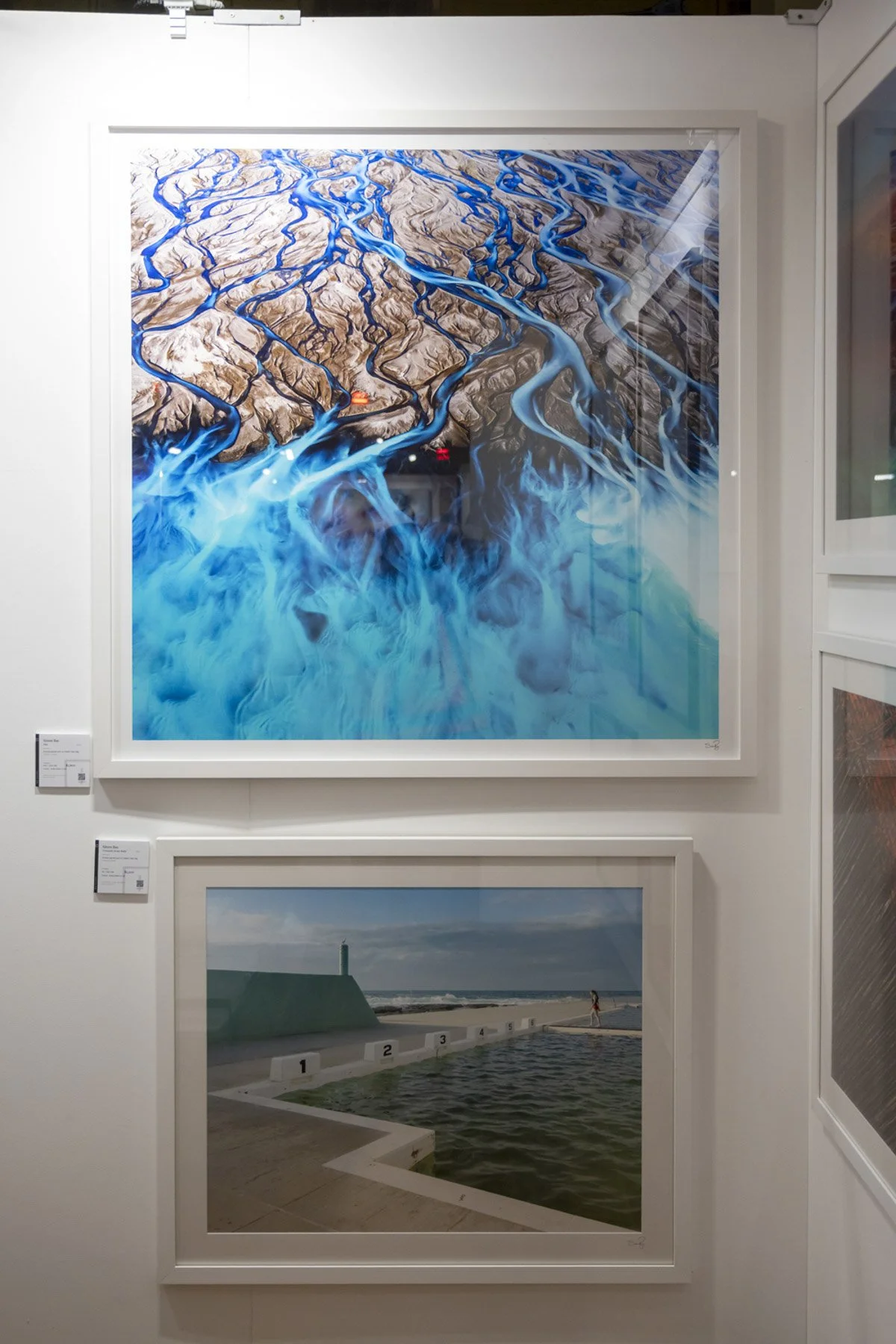
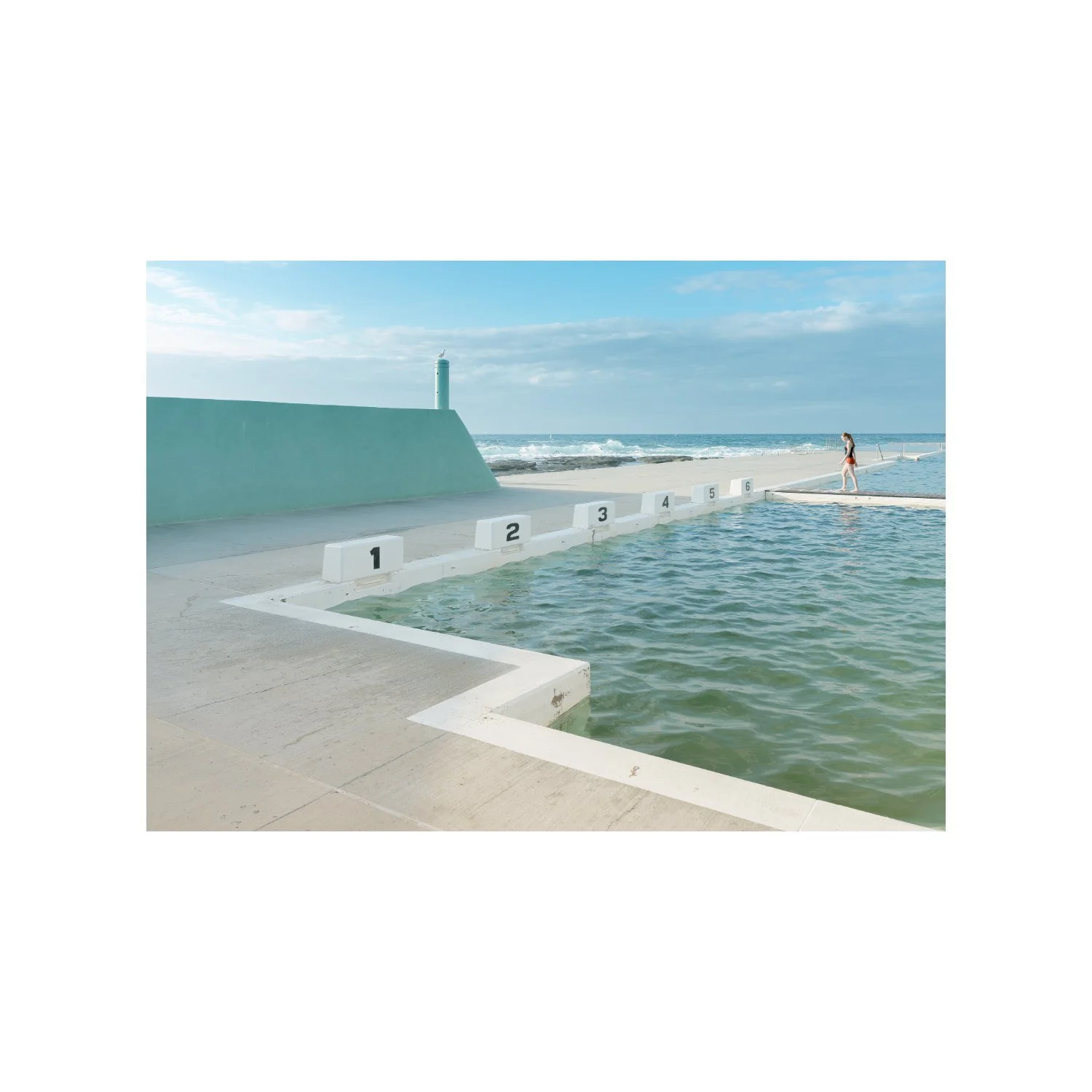
In Flow, a river's tidal channels are seen from directly above, blue veins threading pale sand into something that reads first as abstraction and only later as a place. Newcastle Ocean Baths is an ocean pool at the edge of the sea: the lane markers, the hard geometry of the concrete against the soft disorder of the water. Both find the structure already present in a landscape and wait for it to show.
That is the gig training again, surfacing somewhere unexpected. A band taught him to see the shape inside chaos, to know before the moment arrives where the order will be. From the air that becomes pattern: the channel, the sandbank, a coastline reduced to drawing.
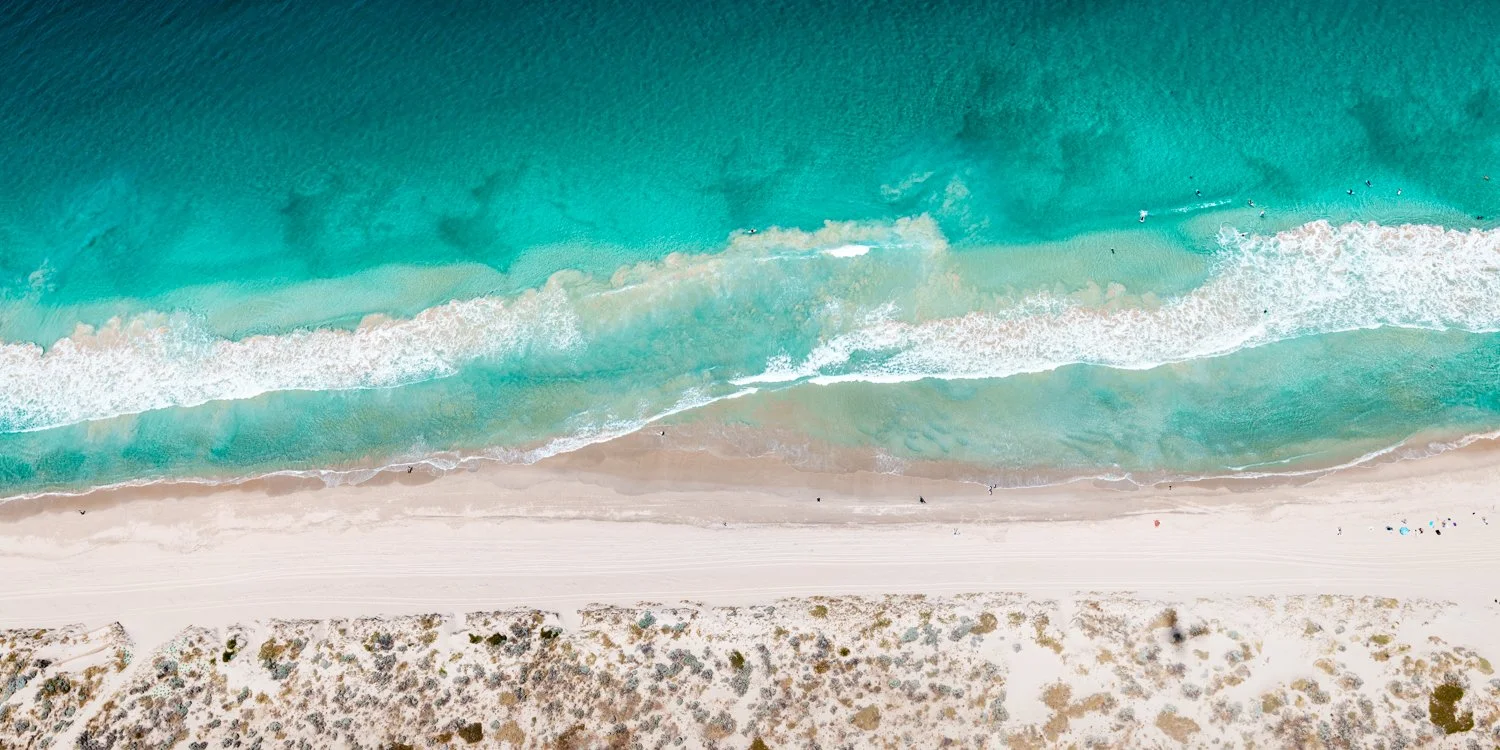
Some landscape photography flatters a place until it becomes a screensaver. Simon looks at a place steadily until it gives up something true, and his strongest images are rarely his most dramatic.
Some landscape photography flatters a place until it becomes a screensaver.On landscape
Mentorship, and the record
Since committing, he has worked under Tony Hewitt through the Mastermind program. Mentorship at that level is interrogation: you bring work and it gets taken apart. A photographer who seeks that out is telling you how seriously they intend to be judged.
The results came steadily: runner-up in the Urban category of the Australian Landscape Photography Awards in 2024, alongside several top-twenty finishes, a top five, multiple silver awards and a gold. Prizes are a slow and imperfect measure. These came from judges with no reason to be kind.
A photographer who makes objects
From early on, Simon took the print seriously. His images are made as physical things, on museum-grade archival paper, produced to last. Most of his IRID editions are printed on Canson Platine Fibre Rag; two, Oceans Embrace and Merewether blocks, are printed on canvas, each an edition of 100 + 2 AP. Merewether blocks runs long and low, at 25 × 102 cm or 38 × 152 cm, which suits a narrow wall above a bench or a bed. He chose the older, harder path of the print, probably because he learned photography when a photograph was only ever an object, and you waited days to find out whether you had one.
Why IRID represents him
We stood on the same headland in 2016, and that is no reason to represent anyone.
IRID represents Simon because the work meets the standard, and because the practice has a shape we trust. It is thirty years long. It went quiet for two decades and came back. Then it was brought into focus, and it has hardened since. For a collector, that shape matters: what you are buying is a position in a practice, and a practice that has already survived a twenty-year interruption tends to survive the ordinary discouragements too.
The slow ones
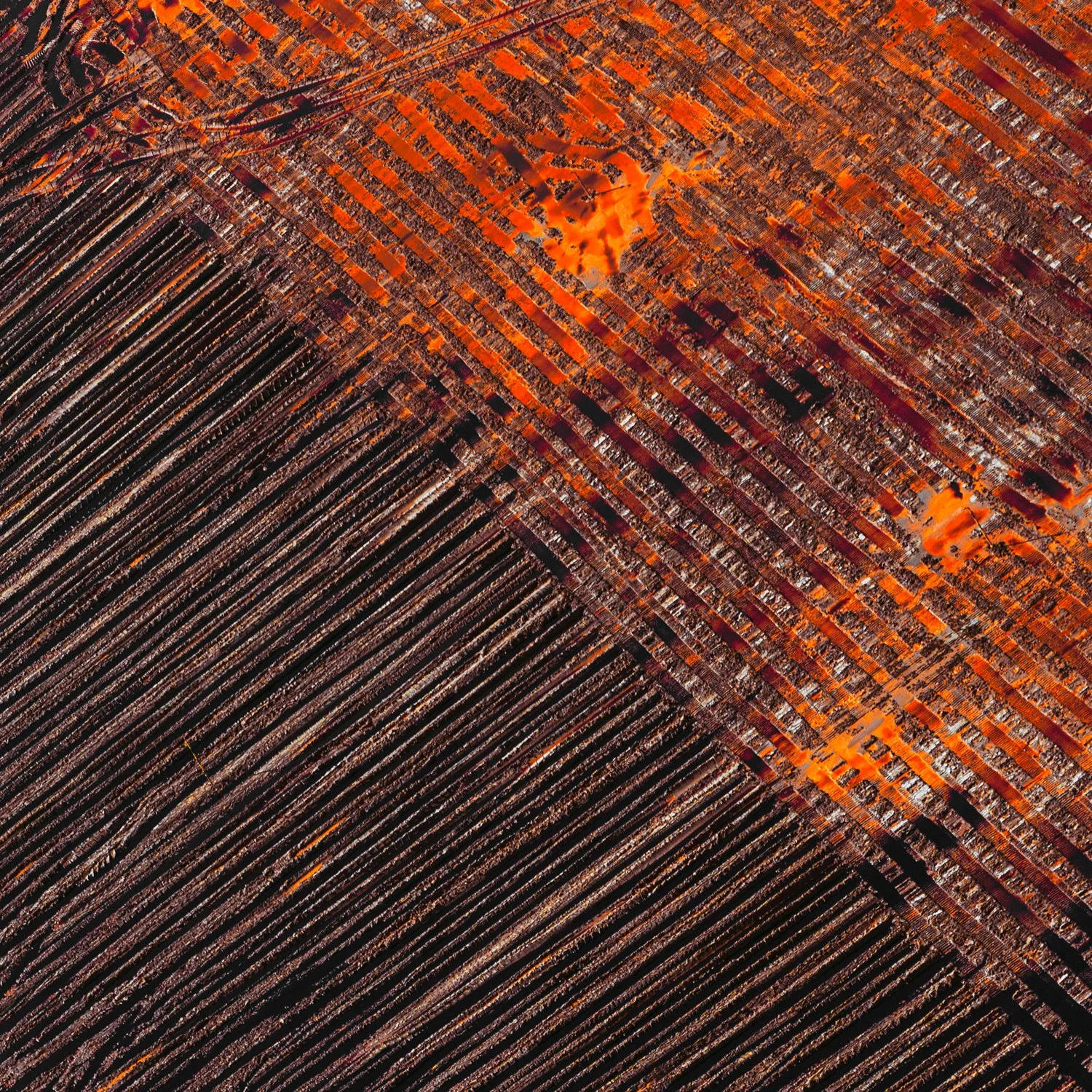
If you are choosing a first Simon Ray, buy for the composition, and look hardest at the Exuviae works. They are editions of 20, most with two artist's proofs, and an IRID edition is counted across all sizes, so twenty is twenty in total. Of everything he makes, they take longest to turn back into ground. Exuviae Crosshatch is rust and hatched line, a surface you take for texture long before you find the land in it. It starts at $700 for a 63 × 63 cm print, or $1,800 framed in white.
Flow is the easier way in, an edition of 100 from $700. Size it to the wall: it runs from 63 to 101 cm square, and at the larger size the channels carry across a room. Oceans Embrace costs $360 as a print and $1,000 on canvas in a natural ash float frame. If the size of the run matters to you, The Number in the Margin explains what it does and doesn't tell you. Whichever you choose, it leaves us with its certificate of authenticity.
I still see that headland in 2016: six of us in the cold, nobody talking, and Simon in no hurry at all, already standing where the light was going to be.
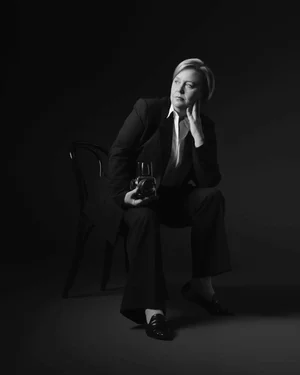
Dani Watson is a photographer and the director of IRID Gallery, which represents contemporary Australian photographers and publishes their work in limited editions.
Simon Ray is represented by IRID Gallery. His editions run from 20 to 100, signed and numbered. If you are weighing one, ask us how it will sit at 63 cm against 101 cm on your wall.
